TL;DR

Get decor and gifts delivered free with Prime
- Fast, free delivery on millions of items
- Prime Video, Amazon Music and more included
- Member-only deals all year
Livingetc has published five lessons drawn from Japanese kitchen storage practices: declutter before adding organizers, choose containers for their function, keep frequently used items handy, use cookware for both cooking and serving, and limit counter displays. The advice is practical design guidance, not a study showing that these methods work for every household.
Livingetc’s report on Japanese kitchen storage sets out five habits for organizing a kitchen: clear out unneeded items before buying storage, match containers to their purpose, keep cooking essentials accessible, choose cookware that can also serve food, and leave only selected items on the counter. The advice is attributed chiefly to London-based interior designer Yoko Kloeden and is presented as design guidance for household kitchens, not as a tested set of rules.
Kloeden’s first recommendation is to declutter before adding organizers. Rather than filling shelves with more containers, she suggests examining what is already stored and asking what each item is for. That approach can prevent purchases that take up space without addressing the underlying clutter. The report frames this as a seasonal check of kitchen cabinets, particularly useful before a period of frequent hosting.
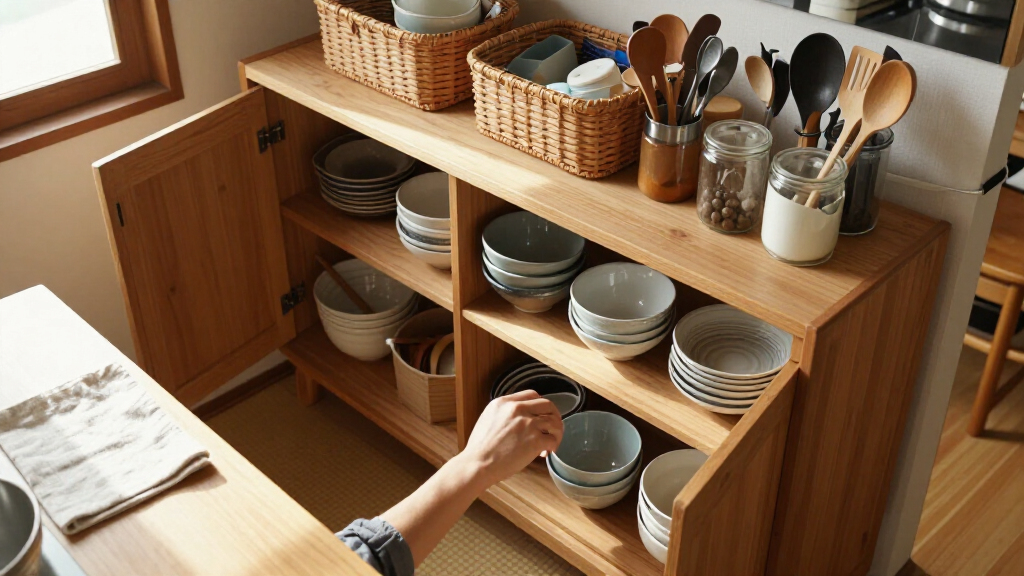
The next two lessons focus on function and access. The report says containers should be chosen for the job they do: clear boxes make contents visible, while Kloeden recommends considering the material and the food being stored. She says salt and sugar can clump and describes keeping them in ceramic jars. For items used repeatedly while cooking, she advises prioritizing easy-to-open vessels and convenient placement, rather than choosing matching containers for appearance alone.
The final lessons concern how objects earn their place. Kloeden describes cookware that can move from cooking to serving as a way to reduce transfers and washing. For counters, she cites a two-part test: an item should be used daily and have visual presence. The report also quotes Tasuku Ogino, executive vice president of Japanese home-goods company Nakagawa, on “merihari,” which he translates as deliberate contrast. Together, the ideas favor useful objects and restrained displays over storing or displaying items by default.
Five Habits for a More Usable Kitchen
The advice matters because kitchen storage decisions affect more than appearance: they shape how easily people find ingredients, prepare meals, and clear up afterward. A decluttering-first approach may help households avoid spending on organizers before they know what needs organizing. Keeping common utensils and seasonings close to the cooking area can also reduce unnecessary searching during meal preparation.
The suggestions are adaptable rather than prescriptive. A home does not need Japanese-made containers or a particular style of cookware to apply the underlying principles. Readers can start by reviewing one shelf, relocating items used often, and checking whether cookware already on hand can serve food at the table. The report does not provide measured results or claim that these steps will work equally well for every kitchen.
Japanese style kitchen storage containers
As an affiliate, we earn on qualifying purchases.
As an affiliate, we earn on qualifying purchases.
The Design Ideas Behind the Advice
The Livingetc report presents the recommendations as lessons from Japanese kitchens, where, according to Kloeden, limited storage can make each container justify its place. It connects the practical advice with two concepts named in the article: ichibutsu tayō, described as one object serving multiple uses, and dashite totonou, rendered as bringing items out while keeping order. These are explanations provided in the report, not independently assessed cultural definitions.
Kloeden founded her London architecture and interior design studio in 2016, according to the source. Ogino is identified as the executive vice president of Nakagawa, a Nara-based home-goods company founded in 1716. Their comments give the article a design and product perspective; they do not amount to a formal survey of Japanese households or evidence that every kitchen follows the described practices.
““Before you add storage, take one shelf and ask what each thing on it is for.””
— Yoko Kloeden, interior designer, as quoted by Livingetc
Limits of the Storage Claims
The supplied report does not specify its publication date, cite research comparing these methods with other storage approaches, or quantify any savings in time, space, or money. Its guidance is based on design advice and attributed comments. The source also does not establish how commonly the practices described are used across Japanese homes, so they should be understood as recommendations from the people quoted rather than universal household rules.
Some details depend on the contents and conditions involved. The article discusses materials and food storage but does not provide a full set of food-safety instructions, including guidance for every ingredient or climate. Readers should follow appropriate storage directions for the specific food and container they use.
Start With One Shelf
The report sets no later milestone or product announcement. Its suggested next step is a small review of existing storage: clear one shelf, identify what each item is for, and remove or relocate what is not needed there before purchasing additional organizers. From there, readers can group frequently used ingredients and tools, choose containers for function, and keep counter displays limited to objects that meet both of Kloeden’s tests.
Key Questions
What are the five Japanese kitchen storage lessons in the report?
Declutter before adding storage, choose containers for their function, keep commonly used cooking items accessible, use cookware that can also serve food, and leave only selected items on the counter.
Does the report say to buy special Japanese organizers?
No. Its central recommendation is to review what is already in the kitchen before buying more organizers. The principles can be applied with items a household already owns.
What should be left on the kitchen counter?
Kloeden’s test, as quoted by Livingetc, is whether an item is used daily and has visual presence. The report does not prescribe a particular number of items or a specific counter layout.
Why use cookware that can also go to the table?
Kloeden says multipurpose cookware can reduce transfers and washing, and may help food arrive hot because it stays in the cooking vessel. The report presents this as design advice rather than a measured result.
Source: rss
Halloween Picks
halloween
As an affiliate, we earn on qualifying purchases.