TL;DR

Get decor and gifts delivered free with Prime
- Fast, free delivery on millions of items
- Prime Video, Amazon Music and more included
- Member-only deals all year
Livingetc’s report says warm, relatively dim evening bulbs can alter how wall paint appears, making some colors look warmer, muddier or flatter than they do in daylight. Designers recommend checking paint in natural light, choosing bulb color temperatures deliberately and using lamps and wall lights to soften and layer illumination.
Warm household lighting can make painted walls look different at night, with some colors appearing warmer and others muddy or flat compared with their daytime appearance, according to a Livingetc report citing interior design and lighting experts. Their suggested response is to assess paint in daylight, choose bulb temperatures with the room’s colors in mind and use layered lamps and wall lights rather than relying on one harsh ceiling fixture.
Paint is perceived through light reflected from its pigments, so the light source affects how the shade appears. Emily Brooks, an interior designer and color consultant, told Livingetc that both the color temperature and strength of the light influence how people see paint. A color selected in natural daylight may therefore look noticeably different under a lamp after sunset.
Jo Plant, chief creative officer at Pooky Lighting, said natural light is around 5,000 Kelvin, while many household bulbs are between 2,500K and 3,000K. Those figures describe color temperature, not the brightness of a bulb. Plant said the warmer evening light can make warm blues feel warmer and can cause cooler hues to look muddy or flat.
The report does not recommend repainting as the first response. Brooks said a color that works in a room’s daylight can also work at night if the evening lighting and bulb temperatures are chosen to suit it. She described paint color, finish and light as interacting parts of the same scheme, and said changing bulb temperature can shift the effect a wall color creates.
How Bulbs Shape Evening Color
The difference matters most in rooms people use after dark, including living rooms and bedrooms. A wall color that seems balanced during a daytime paint test may feel too yellow, too warm or dull once the usual lights are switched on. That can lead people to blame the paint when the evening light is contributing to the change.
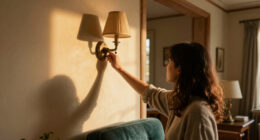
Lighting choices also affect the room’s atmosphere and how much depth the walls appear to have. The report’s experts recommend using more than one light source, since a single bright ceiling fixture can cast a uniform, sometimes harsh light. Lamps and sconces can spread illumination around the room and create a softer, more varied effect. The advice is practical rather than a guarantee: results depend on the specific paint, finish, bulb and fixture.
As an affiliate, we earn on qualifying purchases.
Daylight Tests Miss Evening Conditions
The report addresses a common sequence in decorating: paint is chosen under daylight, but the room is later judged under a different mix of artificial light. Daylight and domestic bulbs are not equivalent; Plant’s cited temperature ranges illustrate why a shade can appear to change even though the paint itself has not changed.
Brooks advised getting the color’s tone and lightness right in the room’s natural daytime state, then building an evening lighting scheme that works with it. That approach treats the paint and lighting as connected decisions rather than assuming a color will appear identical throughout the day. It also avoids treating a nighttime difference, by itself, as evidence that the paint choice was wrong.
““The color or temperature of the light hitting it, and the strength of that light hugely affect how our eyes perceive the shade.””
— Emily Brooks, interior designer and color consultant, speaking to Livingetc
The Right Bulb Depends on the Room
The report provides general guidance, not a universal bulb recommendation or a measured comparison of particular paints under specific fixtures. It does not specify one ideal Kelvin range for every room, color or desired mood. The perceived result can vary with the paint’s undertones and finish, the bulb, fixture placement and the amount of light in the room.
It is also not clear from the report how much any individual wall color will shift in a particular home. Brooks’ examples describe how changing bulb temperature may influence the appearance of a terracotta wall; they are design guidance, not a guarantee that the same adjustment will produce identical results elsewhere.
Test the Room After Dark
For readers reconsidering a paint choice, the report’s advice points to a practical next step: compare the wall in natural daytime light and again at night with the room’s usual fixtures switched on. Try bulb temperatures deliberately and observe how the paint looks before making a larger change. The source does not set out a formal testing protocol, so this is a way to apply the experts’ guidance, not a quoted standard.
Then consider whether the room depends too heavily on one overhead light. Adding or repositioning table lamps and wall lights can create a more layered evening scheme. The eventual choice depends on the look wanted and on how the particular paint responds; the report’s experts do not prescribe a single setup for every room.
Key Questions
Why can paint look different at night?
The light source changes how paint is perceived. Emily Brooks told Livingetc that both light temperature and strength affect how the eye sees a shade. Household bulbs often give off warmer light than daylight, according to Jo Plant.
What bulb color temperature does the report cite?
Jo Plant told Livingetc that natural light is around 5,000 Kelvin, while many household bulbs are between 2,500K and 3,000K. The report does not identify one best temperature for every paint color or room.
Should I repaint if the color looks wrong at night?
Not necessarily. The experts cited by Livingetc recommend checking the evening lighting first. Changing bulb temperature or adding softer light sources may change how the wall appears, though the effect depends on the room and paint.
What kind of lighting does the report recommend?
The report recommends layering light with lamps and wall lights instead of relying only on a harsh central ceiling light or downlights. The right mix depends on the room, fixture placement and desired effect.
Source: rss
Fall Picks
fall essentials
As an affiliate, we earn on qualifying purchases.