
TL;DR

Get decor and gifts delivered free with Prime
- Fast, free delivery on millions of items
- Prime Video, Amazon Music and more included
- Member-only deals all year
A Hunker report describes a DIY vase made by shaping a pool noodle around a cardboard base and toilet paper tube, then covering it with decoupage paper or paint. The project is intended as decorative upcycling; the source does not establish whether the finished piece is waterproof or suitable for holding water and fresh flowers.
A Hunker DIY report describes how to turn a pool noodle, including one bought at Dollar Tree for $1 according to the article, into a vintage-inspired vase using cardboard, a toilet paper tube and decoupage. The project offers a way to reuse leftover foam, but the finished object is presented as decorative: the report does not say it is waterproof or suitable for holding water.
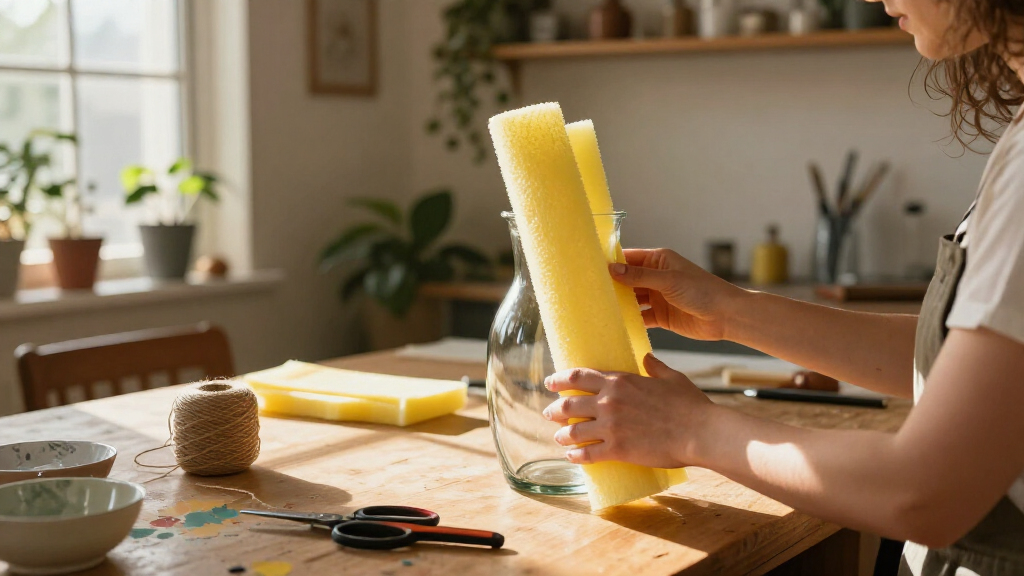
The construction uses a short piece of pool noodle as the vase’s curved body. The maker cuts small wedges from both ends, brings the ends together and inserts an empty toilet paper tube into the opening to form the neck. Hot glue and masking tape hold the noodle around the tube. A second noodle section is split lengthwise and fitted around the exposed tube, hiding it.
For the base, the maker cuts an opening across the bottom of the loop to match a small cardboard box, then attaches the foam to the box with hot glue and masking tape. The report lists a utility knife, ruler, scissors, paintbrush and glue gun among the tools. Because the process includes cutting and hot glue, careful handling is needed; the source does not provide a safety guide.
The finish is made by mixing two parts glue with one part water. The maker separates a patterned napkin from its white backing, applies the backing in strips as a base layer, then brushes on the patterned paper. Hunker also describes painting as an alternative, including textured spray paint to help conceal the foam. The vase should be left to dry before decorative stems are added.
A Low-Cost Use for Leftover Foam
The project is relevant to readers looking for a small-scale upcycling craft rather than a functional replacement for a ceramic vase. It uses common household materials and allows the exterior to be customized with napkins or paint, so the design can be adapted to different floral styles without requiring a new, purpose-made vessel.
Its practical limits matter. The reported structure is made from foam, paper, glue, tape and cardboard, and the source does not describe a waterproof seal or test the vase’s ability to support heavy stems. Readers should treat it as a decorative cover or display piece and use artificial flowers or dry stems unless they independently establish that their version can safely hold water.
Products Worth Considering

Shark Rocket Corded Stick Vacuum (HV301) – Gray/Orange

LEVOIT Vital 200S-P Smart Air Purifier for Large Rooms

Bose TV Speaker Compact Soundbar with Bluetooth and HDMI-ARC, Black
As an affiliate, we earn on qualifying purchases.
How the Decoupage Vase Is Built
Hunker credits the step-by-step inspiration to YouTube creator NamrataALLINONE, whose video demonstrates the process. The report frames the look as vintage-inspired and points to floral napkins as a way to reinforce that style. Its reference to 1980s-inspired floral decor is design context, not evidence that the craft itself is a new trend or a formally established technique.
Decoupage involves adhering paper to a surface with a glue mixture. In this project, the paper layers cover the noodle and help unify the assembled parts visually. Hunker says the noodle’s original color does not matter because it will be covered. It also notes that a textured paint finish can be used instead of napkins, giving makers a simpler alternative to cutting and layering paper.
““the materials list for this project is small and composed largely of things you may already have around the house.””
— Hunker
Water Resistance and Stability Are Unverified
The source does not give dimensions, drying times, a weight limit or details of any waterproof coating. It also does not report testing the vase with water or fresh flowers. Since the described base includes cardboard and the surface uses paper and a diluted glue mixture, water resistance should not be assumed.
Hunker does not specify how long the finished vase lasts, whether the glue bonds securely to every type of pool noodle, or how the structure performs with taller or heavier arrangements. The article’s suggestion to add festive stems or artificial blooms does not establish that the vase can safely hold them; lightweight, dry or artificial stems are the more cautious choice.
Dry Fully Before Decorating
The steps described by Hunker end with allowing the chosen finish to dry before adding decorative stems. The report does not announce a product launch, scheduled follow-up or further test, so there is no additional development identified. Readers who try the craft can choose between a napkin decoupage finish and paint, and should keep the arrangement lightweight unless the finished piece’s stability has been checked.
Key Questions
What materials are needed for the pool noodle vase?
The Hunker report lists a pool noodle, an empty toilet paper tube, a small cardboard box, masking tape and glue. Tools include a utility knife, hot glue gun, paintbrush, ruler and scissors. Patterned paper napkins are used for the decoupage finish; paint is an alternative.
How does the vase get its shape?
Wedges cut from the noodle’s ends are brought together around the toilet paper tube, which forms the neck. A split piece of noodle covers the tube, and the loop is attached to a cardboard box to form a base.
Can it hold water and fresh flowers?
The source does not say that the finished craft is waterproof or tested for water. Since it uses cardboard and paper, treat it as a decorative piece and use artificial or dry stems unless you have established that your version can safely contain water.
Can I use paint instead of napkins?
Yes. Hunker describes painting as an alternative to decoupage and notes that textured spray paint may help conceal the pool noodle’s surface. Follow the paint label’s directions and allow the finish to dry before adding decorations.
Source: hunker.com