TL;DR

Get decor and gifts delivered free with Prime
- Fast, free delivery on millions of items
- Prime Video, Amazon Music and more included
- Member-only deals all year
Palazzo Sogni is a new 30-room hotel near Florence’s Duomo, created inside a 16th-century palazzo. Designers Elena and Giulia Sella say the project preserves historic frescoes and a fountain while introducing custom furniture, textiles and finishes made with local and Italian craftspeople.
Palazzo Sogni, a new 30-room hotel near Florence’s Duomo, has brought guest rooms and shared spaces into a 16th-century palazzo while retaining historic frescoes and a monumental fountain. Designers Elena and Giulia Sella developed custom interiors with Florentine and regional artisans, making the project both a hospitality opening and a conservation-led design effort.
The building once formed part of Palazzo Testa, constructed by the Martelli family in the 16th century. Its notable features include a monumental nymphaeum and stone fountain, traditionally attributed to sculptor Baccio Bandinelli, as well as frescoes from different periods, including works by Luigi Catani and Antonio Marini. Design Milk reports that conservation work removed layers of paint to uncover decorations that had been concealed.
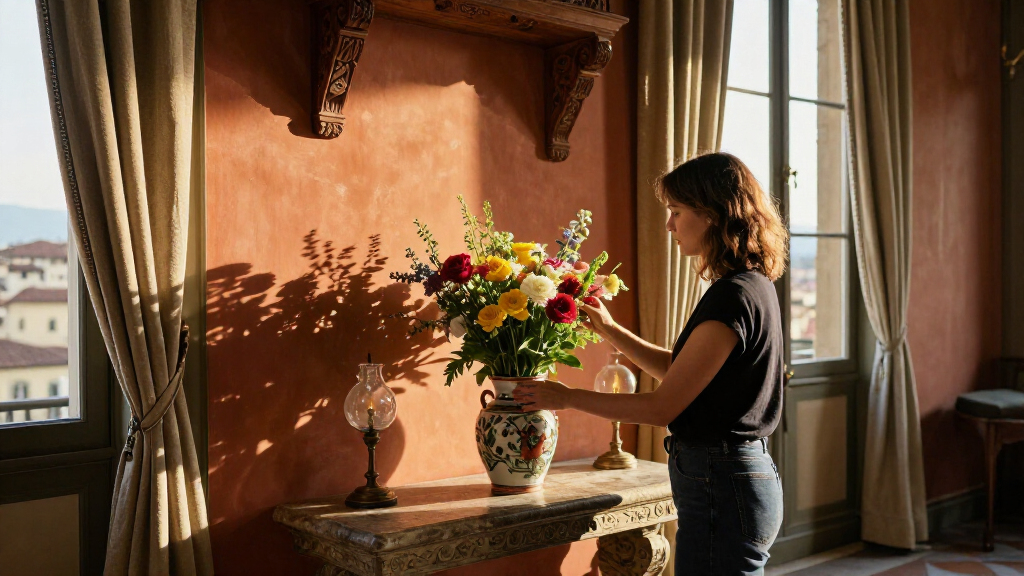
The Sella sisters restored original ceiling frescoes and recreated marble flooring to echo the palazzo’s checkerboard pattern. The 30 rooms and suites take different forms: the designers drew color and material choices from the historic decoration and adapted furniture layouts to each room’s proportions. Integrated lighting highlights ceiling and wall paintings, while features such as chaise longues and separate seating areas vary by room.
Rather than use existing furniture collections, the designers commissioned pieces for the hotel, including beds, wardrobes, seating, tables and lighting. Local production also shaped the textiles: Florence-area company Alessandro Bini developed the hotel’s Floral Butterfly pattern as a silk-based jacquard, while Italian maker Rivolta Carmignani supplied bespoke linens and terry goods. Ginori 1735 adapted its Antico Doccia tableware with the hotel’s powder-blue color and floral and butterfly motifs.
A Hotel Built Around Florence’s Craft
The project places historic conservation and contemporary hospitality in the same setting. Rather than treating the frescoes and fountain as scenery, the designers say they used the existing architecture to guide room layouts, lighting, colors and materials. The result gives the property an identity tied to this particular building instead of relying solely on standardized furnishings.
Its commissioning of furniture and textiles also connects the hotel’s design to Florentine and Italian production. That matters to visitors interested in how local craft enters contemporary hotels, and to a city where new uses for historic buildings must contend with the preservation of architectural features. The source describes the design approach, but does not provide information about the hotel’s rates, occupancy or wider economic impact.
For guests, the practical difference is a property whose rooms are not presented as identical units: the designers say each responds to the frescoes and proportions of its space. Shared features, including the Secret Garden, give the building’s historic elements a role beyond the guest rooms.
Products Worth Considering

Dyson V8 Cordless Vacuum

Shark Navigator Robot Vacuum with Self-Empty Base, Dark Grey (RV2120AE)

eufy E25 Robot Vacuum and Mop Combo with HydroJet Roller Mop
As an affiliate, we earn on qualifying purchases.
From Palazzo Testa to Hotel
Palazzo Sogni occupies a building dating to the 16th century, when it was part of Palazzo Testa, according to Design Milk’s report. The property’s historic decoration spans several centuries. The nymphaeum, with its stone fountain traditionally attributed to Baccio Bandinelli, is among the site’s most prominent architectural features.
The renovation involved revealing and restoring earlier details rather than replacing them with a uniform new finish. The designers describe preserving original lime-based wall finishes where possible and restoring ceiling paintings. New elements—including powder-blue accents, amber-toned mirrors and custom furnishings—were chosen in response to the existing interiors. The mirror appears in several parts of the property, including bathrooms and elevators.
The hotel’s Secret Garden is arranged around the nymphaeum and fountain. A view from the entrance leads toward the feature, while planting, custom furniture and lighting frame it. The designers said they wanted the fountain to remain a strong architectural presence, rather than allowing new landscaping or furnishings to dominate it.
Opening Details Still Unspecified
The report does not give a specific opening date, hotel rates, booking information or details about the renovation’s cost and duration. It also does not say how many frescoes were uncovered, what conservation methods were used, or whether all historic rooms and features are accessible to hotel guests.
The fountain is described as traditionally attributed to Baccio Bandinelli; that wording does not establish authorship as confirmed. The source focuses on the design and restoration, and does not independently assess the conservation work or report statements from preservation authorities. Further information about those points is not included in the available account.
Guest Access and Hotel Details
Travelers seeking to visit will need to check Palazzo Sogni’s current booking information for availability, room rates and any access arrangements for the Secret Garden or other historic spaces. Those details are not provided in Design Milk’s report.
Further reporting could clarify the project’s opening timeline, conservation approvals and the extent to which the restored areas are open to guests. For now, the confirmed development is the hotel’s design and its stated combination of restored architectural features with custom-made interiors.
Key Questions
Where is Palazzo Sogni?
Palazzo Sogni is in Florence, a short distance from the Duomo, according to Design Milk’s report.
How many rooms does the hotel have?
The property has 30 rooms and suites. The designers say their interiors vary according to the historic decoration and proportions of each room.
What historic features were retained?
The project retained and restored ceiling frescoes, recreated a marble floor pattern inspired by the original checkerboard design, and centered the Secret Garden on a historic nymphaeum and stone fountain.
Who designed the interiors?
Elena and Giulia Sella designed the interiors and commissioned bespoke furniture and other pieces for the hotel, working with artisans and businesses in Florence and the surrounding region.
When did Palazzo Sogni open, and how can guests book?
The source report does not specify the opening date, rates or booking arrangements. Travelers should consult the hotel directly for current availability and guest-access details.
Source: design-milk.com