TL;DR

Get decor and gifts delivered free with Prime
- Fast, free delivery on millions of items
- Prime Video, Amazon Music and more included
- Member-only deals all year
A Veranda report draws on advice from designers Kate Marker and Jessica Kain Barton for lighting dressing rooms with a mix of decorative overhead fixtures and task lighting. They recommend warm bulbs for general use, face-level sconces to reduce shadows, and dimmers; vanity lighting may call for a different bulb temperature.
Interior designers Kate Marker and Jessica Kain Barton recommend combining overhead and task lighting rather than relying on a single ceiling source in dressing rooms, according to a Veranda report. Their guidance focuses on making these compact spaces comfortable for everyday use while providing practical light for dressing and grooming.
Marker, an interior designer who recently released a lighting collection with Mitzi of Hudson Valley Lighting Group, says a dressing room should feel personal and inviting as well as functional. She recommends layering ambient and task lighting, with a pendant or small chandelier providing a decorative focal point and smaller fixtures supporting specific activities.
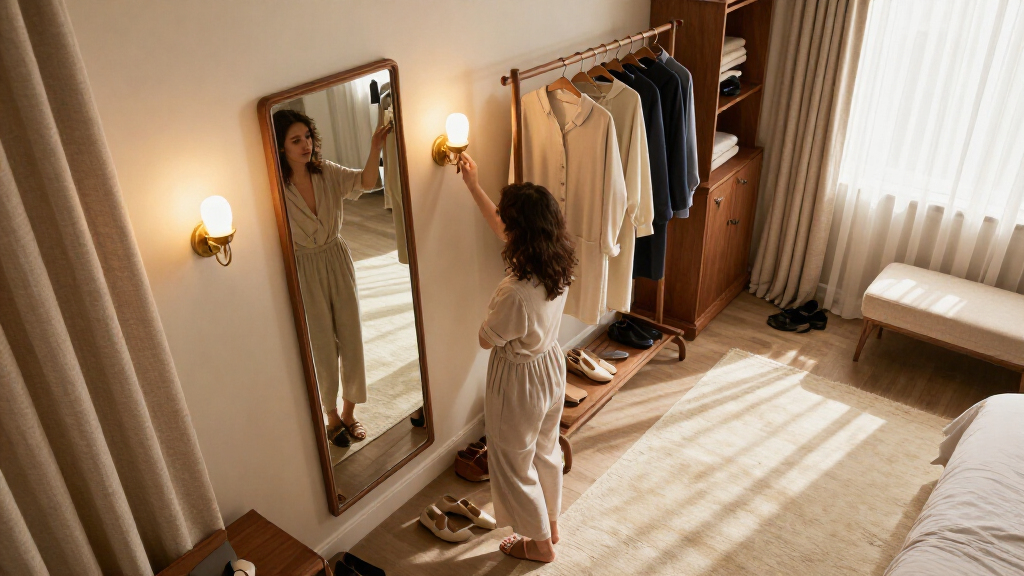
For light around a mirror, Marker favors sconces placed at face level, saying that this can help minimize shadows. Barton, the Louisville-based founder of J. Kathryn Interiors, also recommends sconces, including small library-style fixtures beside a makeup vanity. For overhead lighting, Barton suggests a chandelier, lantern or flush mount fitted with at least three or four candle bulbs.
The designers advise against using recessed fixtures as the only source of light. Marker says they can feel harsh and produce unflattering shadows. If recessed lighting is needed, Barton recommends limiting it to no more than four fixtures, ideally mud-in style and no wider than three inches in diameter. Both designers name 2700K bulbs as their general preference; Marker suggests 3000K bulbs with excellent color rendering for vanity lighting and recommends putting decorative fixtures on dimmers.
Lighting for Dressing and Grooming
The recommendations address a practical problem in dressing rooms: light that feels pleasant may not provide enough clarity for choosing clothes or grooming, while a single bright overhead source can cast shadows. A layered setup gives residents more than one way to light the room, with overhead fixtures for general illumination and mirror-side lights for tasks.
Bulb temperature and dimmers also allow the room’s lighting to serve different purposes. Marker’s suggestions distinguish between warm general lighting and brighter vanity lighting, while dimmers let users adjust decorative fixtures. These are designers’ recommendations, not a universal lighting standard or a guarantee that a particular setup will suit every room.
Products Worth Considering

PHILIPS Hue Smart LED Candle Light Bulb, B39, E12, 2-Pack

TCL 65-Inch QM6K QLED Mini-LED 4K HDR Smart Google TV, 144Hz

TCL 65 Inch QM8L Series SQD-Mini LED QLED 4K Smart Google TV
As an affiliate, we earn on qualifying purchases.
From Private Room to Daily Routine
The Veranda report describes dressing rooms as spaces with a long history as private rooms adjoining bedrooms, where people could dress and attend to personal routines. Their contemporary use remains personal, but lighting choices now play a central role in balancing atmosphere with everyday tasks.
Marker frames the room as a small boutique and emphasizes decorative fixtures, including materials such as fabric and patinated brass. Barton takes a simpler approach, favoring warm light and restrained fixtures. The shared advice is to avoid treating the ceiling light as the entire plan and to consider how mirrors, cabinetry and the vanity are used.
“My biggest must-do [when decorating a dressing room] is layering lighting. You want a combination of ambient and task lighting so the room feels warm and inviting but is still functional.”
— Kate Marker, interior designer
Room Conditions Still Matter
The report does not give room dimensions, fixture spacing plans, measured light levels or a tested comparison of the recommended bulb temperatures. It also does not specify whether every dressing room will have the same needs; ceiling height, available daylight, mirror placement and the intended use of a vanity can affect fixture choices.
The guidance is attributed to two designers and should be read as professional advice rather than a formal lighting specification. The source does not provide a cost range or a product-by-product comparison, and it does not establish that a particular fixture arrangement will suit all homes.
Applying the Advice at Home
The report offers design guidance rather than announcing a planned project or follow-up. Readers applying it can start by identifying the room’s main tasks, then consider a decorative overhead fixture alongside lighting near a mirror or vanity. Marker and Barton’s recommendations point to warm general bulbs, appropriate vanity lighting and dimmers for decorative fixtures.
Before choosing products, homeowners will need to account for their room layout, existing wiring and the fixtures’ installation requirements. Electrical work should be handled by a licensed professional, with power switched off and appropriate safety precautions followed during any permitted work. The report provides no further update or timetable for additional guidance.
Key Questions
What lighting do designers recommend for a dressing room?
The Veranda report quotes Kate Marker and Jessica Kain Barton recommending a combination of overhead ambient lighting and task lighting, such as sconces near a mirror or vanity.
What color temperature do they suggest?
Both designers name 2700K bulbs as their general preference. Marker recommends 3000K bulbs with excellent color rendering for vanity lighting.
Are recessed lights suitable for dressing rooms?
The designers say recessed lights should not be the only source. Barton suggests no more than four, preferably mud-in fixtures no wider than three inches in diameter, when recessed lighting is needed.
Why place sconces beside a mirror?
Marker says face-level sconces can help minimize shadows while getting ready. Barton also recommends small library-style sconces beside a makeup vanity.
Should dressing-room lights be on dimmers?
Marker recommends putting decorative lighting on dimmers so users can adjust the room’s brightness and feel.
Source: veranda.com