To boost your DIY candle’s scent throw, choose a wax like paraffin or a blend with additives like Vybar, which improve fragrance diffusion. Use high-quality, strong fragrance oils and preheat your container to help with scent dispersion. Maintain the correct wax temperature (around 135-145°F) when pouring, select the right wick for your wax and container, and allow your candles to cure for 1-2 weeks. Keep these tips in mind for a more aromatic candle experience, and you’ll discover even more ways to strengthen your scent throw as you go.
Key Takeaways
- Choose waxes like paraffin or microcrystalline blends with additives such as Vybar to improve fragrance diffusion.
- Use high-quality, concentrated fragrance oils and blend them thoroughly for a stronger, more complex scent.
- Preheat containers slightly to enhance wax adhesion and fragrance integration during pouring.
- Select the right wick size and material, like cotton or wood, to ensure efficient heat transfer and optimal scent release.
- Cure candles for 1-2 weeks and pour at optimal temperatures to strengthen scent bonds and maximize throw.
Choosing the Right Wax for Better Scent Diffusion

Choosing the right wax is essential if you want your candles to have a strong, lasting scent throw. Different waxes have unique wax characteristics that affect how well fragrances disperse. For example, paraffin wax typically offers good scent diffusion because of its porous structure, allowing fragrance oils to blend effectively. On the other hand, soy wax tends to have lower fragrance solubility, which may limit scent strength unless properly blended. Understanding these wax characteristics helps you select a wax that enhances scent throw and maintains fragrance integrity during burning. When evaluating wax options, consider how well the wax interacts with your chosen fragrance oils and whether it supports proper solubility. This choice sets the foundation for a candle with a robust and consistent aroma.
Selecting Stronger Fragrance Oils and Proper Blending Techniques
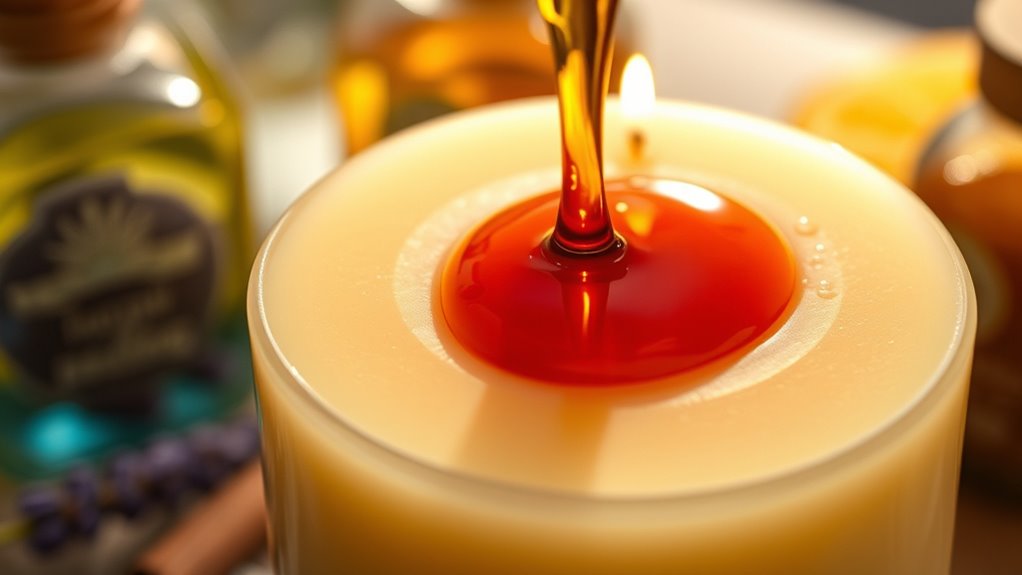
To enhance your candle’s scent throw, selecting stronger fragrance oils and mastering proper blending techniques are crucial steps. Your fragrance oil selection plays a key role—opt for oils with higher concentration and quality to maximize scent strength without overpowering. When blending, start with a balanced ratio, combining different oils to create a more complex aroma. Use blending techniques that ensure even distribution of fragrance throughout the wax. Gently mix the oils thoroughly before pouring, avoiding agitation that can introduce air bubbles. Remember, a well-chosen fragrance oil paired with effective blending techniques results in a more potent and long-lasting scent. Understanding fragrance load and its optimal levels can significantly improve your candle’s aroma performance. Additionally, paying attention to scent retention can help maintain the strength of your candles over time. Proper wax temperature during pouring can also influence scent dispersal and overall scent throw. To further optimize scent throw, consider experimenting with wick selection, as a suitable wick can enhance scent diffusion when burning.
Wax Temperature and Pouring Methods to Lock in Fragrance
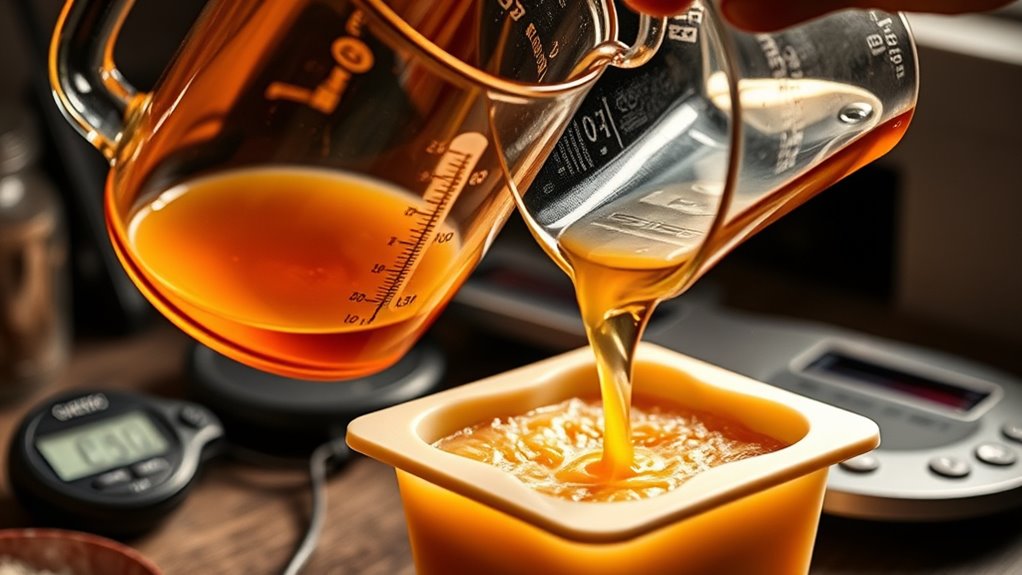
Getting your wax to the right temperature is key to locking in fragrance. Pouring at the ideal temperature guarantees better scent throw and a smooth finish. Pay attention to your pouring technique to maximize scent retention and achieve a professional look. Incorporating vintage decor and rustic elements into your workspace can also inspire a more authentic and satisfying candle-making experience. Additionally, using proper temperature control tools can help maintain consistent wax temperatures for optimal results. Monitoring air quality in your workspace can ensure a healthier environment during the candle-making process.
Optimal Wax Temperature
Have you ever wondered how the temperature of your wax affects the strength of your candle’s fragrance? The best wax temperature ensures your scent layers properly, enhancing fragrance longevity and overall throw. When you pour at the right temperature—usually around 135°F to 145°F for most waxes—you allow the fragrance oils to blend seamlessly with the wax, locking in the scent more effectively. Too hot, and the fragrance can evaporate or become uneven; too cold, and it may not bind well, resulting in weak scent throw. Maintaining this ideal temperature helps create a uniform surface and promotes better scent layering during curing. Adjusting the cooling process can further improve how well your candle retains its scent over time. By paying close attention to your wax’s temperature, you maximize fragrance retention and achieve a more powerful, lasting aroma in your finished candles. Proper wax temperature control is crucial for consistent, high-quality scent throw in DIY candles.
Pouring Technique Tips
Proper pouring technique is crucial for locking in fragrance and ensuring an even, vibrant scent throw. To achieve this, pour your wax at the right temperature—typically slightly below the flash point—to prevent fragrance evaporation. When using scent layering techniques, pour the first layer at a specific temperature, then allow it to set before adding subsequent layers, which helps trap and intensify the scent. Consistency in wax temperature helps distribute fragrance evenly throughout the candle, boosting scent throw. Be mindful of pouring slowly and steadily to avoid air bubbles that can disrupt scent diffusion. Practicing precise wax temperature control combined with thoughtful scent layering ensures your candles emit a stronger, more balanced aroma, enhancing the overall scent throw and creating a more enjoyable experience. Additionally, understanding the Fokos can help you choose the best waxes and additives to maximize fragrance retention and scent throw. Proper temperature control can also help prevent scent loss during the pouring process, leading to a more potent aroma. Monitoring the wax temperature with a thermometer can further improve your scent throw by maintaining optimal conditions throughout the pouring process. Using fragrance oils designed for candle making can also significantly enhance scent throw and overall fragrance strength.
Using the Correct Wick Size and Material for Optimal Scent Throw
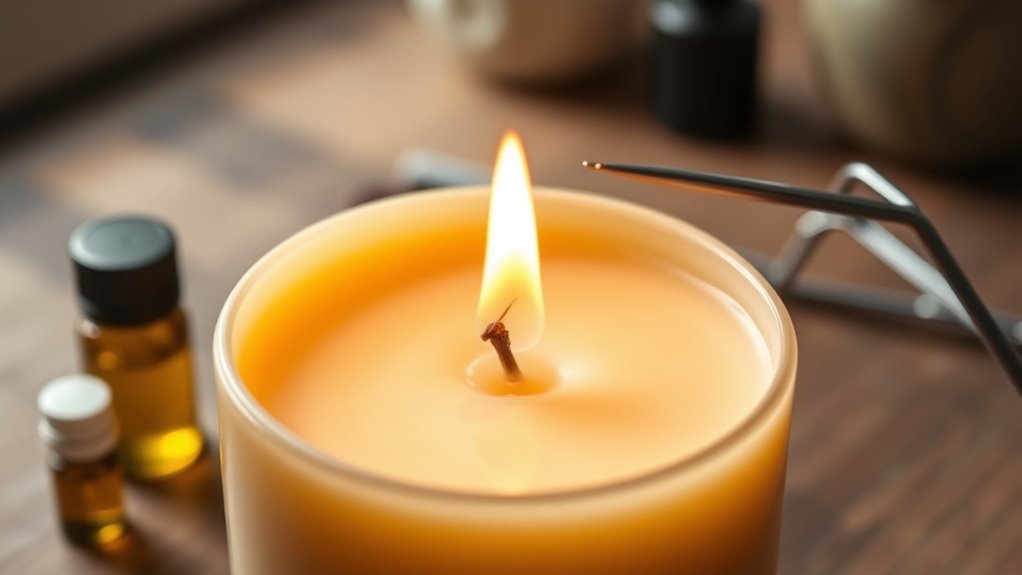
Choosing the right wick size guarantees your candle burns evenly and releases the full scent. The wick’s material and diameter must match your candle’s container and wax to optimize heat transfer. When you select the proper wick, you’ll get a stronger, more consistent scent throw with less soot or tunneling. Additionally, understanding the performance of different wick materials can further improve your candle’s overall scent distribution. Selecting a wick with the appropriate combustion efficiency can help minimize soot production and ensure a cleaner burn, enhancing the scent throw even further.
Wick Diameter Compatibility
Selecting the right wick diameter is essential for achieving a strong scent throw because it directly influences how the candle burns and distributes fragrance. If your wick is too small, it won’t produce enough heat to melt the wax evenly, limiting scent diffusion. Conversely, a wick that’s too large can cause excessive heat, leading to rapid burning and potential safety issues. Ensuring wick compatibility with your candle size and wax type guarantees a consistent burn pool, which helps maximize fragrance release. Always choose a wick diameter suited to your candle’s dimensions, and verify the wick material’s ability to handle the wax’s melting point. Proper wick compatibility results in a steady burn, efficient fragrance dispersal, and ultimately, a more powerful scent throw. Additionally, understanding automation in business can help streamline your candle-making process, ensuring consistent results and optimal scent distribution. Incorporating consistent quality control practices can further enhance the effectiveness of your scent throw and overall candle performance.
Material Heat Conductivity
Material heat conductivity plays a crucial role in how effectively your candle releases fragrance. The better the material’s heat conductivity properties, the more evenly heat distributes across the wax, enhancing scent throw. Choosing wicks made from materials with high heat conductivity ensures consistent melting, which helps fragrance oils disperse properly. Additionally, understanding the heat transfer properties of wick materials can assist in selecting the ideal wick for your specific wax and fragrance combination. Conversely, low conductivity materials may cause uneven melting, reducing scent performance. To optimize scent throw, consider these tips:
- Select wicks with high conductivity properties suited for your wax type.
- Use materials like cotton or wood that transfer heat efficiently.
- Avoid wicks with poor heat conductivity, which can hinder fragrance release.
- Being aware of the fire safety considerations involved in candle making can help prevent hazards associated with improper materials or handling.
Understanding how material heat and conductivity properties influence heat transfer helps you craft candles with a stronger, more consistent scent throw.
Proper Wick Sizing
The right wick size and material are essential for maximizing your candle’s scent throw because they directly influence how evenly and efficiently the wax melts. Proper wick selection ensures a consistent, full melt pool that releases fragrance effectively. If the wick is too small, the wax may not melt fully, reducing scent dispersion. Conversely, an oversized wick can cause excessive burning and tunneling, wasting wax and diminishing scent throw. To find the best fit, perform wick testing with different sizes and materials—such as cotton or wood wicks—to observe how they burn and melt. This process helps you identify the ideal wick that delivers a strong, even scent throw while maintaining a clean burn. Additionally, understanding airless sprayer maintenance can help you optimize your candle-making process by fine-tuning each element for better performance. Proper wick sizing is key to crafting candles with optimal fragrance performance****, ensuring your candles release scent more effectively and consistently.
Incorporating Additives to Enhance Fragrance Release

Adding certain additives to your candle wax can considerably boost how well your fragrance disperses. These additives can improve the scent throw when combined with your chosen essential oil blends. To maximize effectiveness, consider these options:
- Stearic Acid – Enhances wax opacity and may improve scent throw when compatible with your wax type.
- Vybar – Improves fragrance retention and wax hardness, increasing scent diffusion.
- Vybar and Microcrystalline Wax Blends – Ensure additive compatibility to enhance scent throw without compromising candle performance.
- Always check additive compatibility with your wax and fragrance oils to prevent appliance compatibility issues that could affect your candle’s performance. Properly blending these additives allows your fragrance to diffuse more evenly and strongly, resulting in a more powerful scent throw in your DIY candles. Additionally, understanding industry standards can help you select the most effective additives for your specific candles.
Preheating Your Container for Improved Fragrance Dispersion

Preheating your candle container before pouring the wax can markedly improve how your fragrance disperses. Container preheating helps create a better bond between the wax and the container, allowing the scent to spread more evenly and strongly. To do this, warm your container gently—using warm water or a heat gun—until it’s just warm to the touch. Avoid overheating, which could crack or damage the container. When you pour the melted wax into a preheated container, the wax cools more gradually, encouraging better fragrance integration. This process enhances scent dispersion, resulting in a stronger, more consistent throw. Preheating your containers is a simple step that significantly boosts your candle’s scent performance without adding complexity to your process.
Proper Curing Time to Maximize Scent Intensity
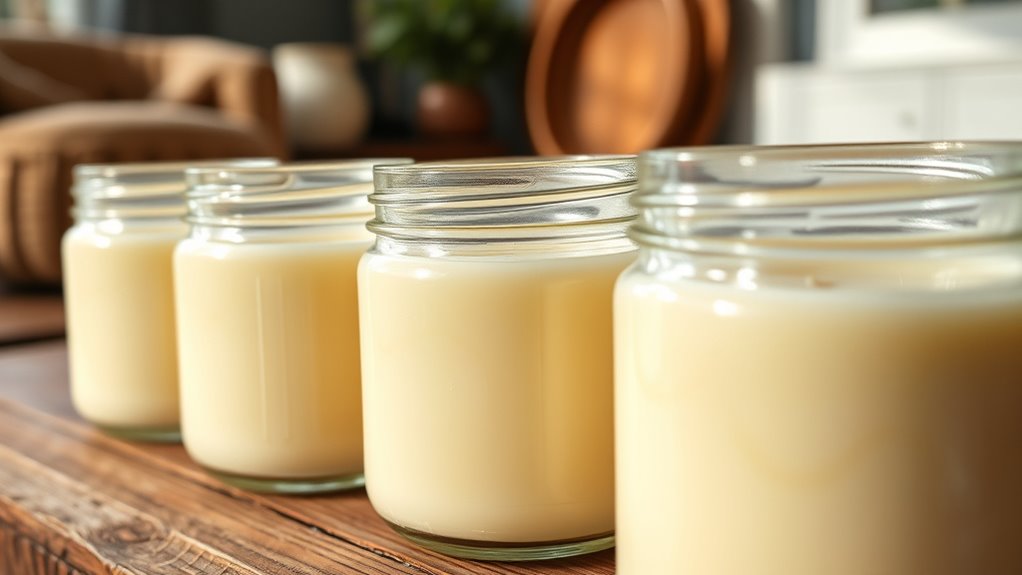
Allowing your candle to cure properly after pouring is essential for maximizing its scent strength. The curing process allows the wax and fragrance oils to fully meld, resulting in better scent maturation and stronger aroma diffusion. During this time, the scent develops fully, enhancing the candle’s overall throw. To optimize this process, keep these tips in mind:
- Let your candles cure for at least 1-2 weeks before burning.
- Store them in a cool, dark place to prevent scent loss.
- Avoid moving or disturbing the candles during curing to ensure even scent maturation.
Patience during the curing process considerably boosts scent intensity, giving you a richer, more robust fragrance when lit. Proper curing is the key to achieving the strongest scent throw possible.
Maintaining Candle Quality for Consistent Aroma Distribution

Once your candles have cured properly, maintaining their quality becomes key to guaranteeing consistent aroma distribution. Proper candle storage helps preserve scent integrity over time; keep your candles in a cool, dark place away from direct sunlight and temperature fluctuations. This prevents scent fading or alterations. Additionally, consider scent layering techniques when creating your candles—adding complementary fragrances can enhance overall aroma complexity and strength. Avoid mixing incompatible scents, as this can weaken or distort the intended fragrance profile. Regularly inspecting your candles ensures they remain in good condition, free from dust or debris that could interfere with scent throw. By carefully managing storage conditions and thoughtfully layering scents, you help your candles deliver a consistent, strong aroma with every burn.
Troubleshooting Common Scent Throw Issues and Solutions
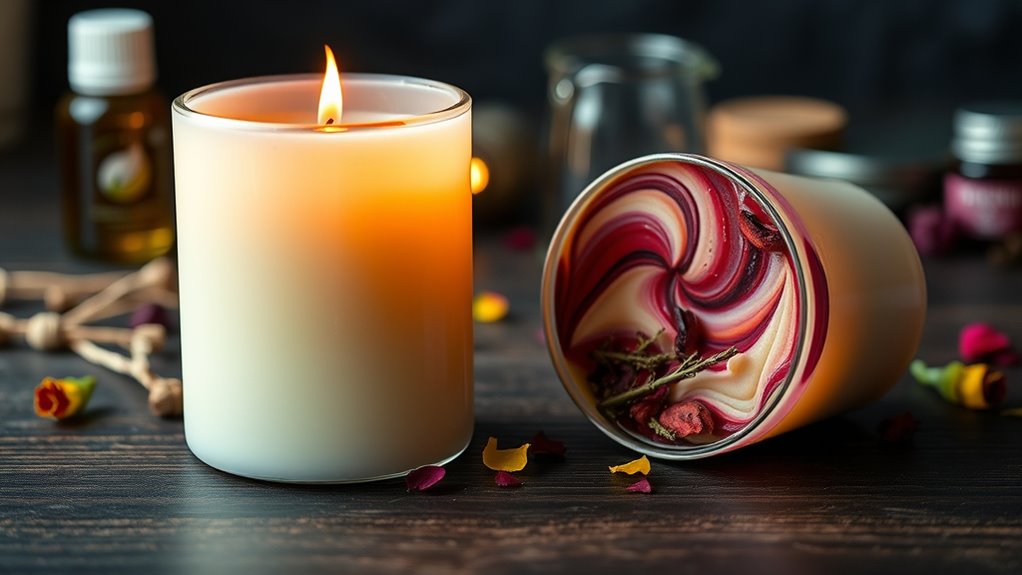
If your candle isn’t producing a strong scent throw, several common issues could be at play. First, your fragrance load might be too low; increasing it can boost scent strength. Second, poor wax-fragrance blending could hinder scent diffusion—try stirring thoroughly or using scent layering techniques for better integration. Third, improper curing time may prevent ideal scent release; let your candles cure longer before burning. Additionally, experimenting with fragrance layering can create a more complex, stronger aroma. Ensure your scent layering techniques involve layering fragrances with complementary notes to enhance overall throw. These adjustments can markedly improve your candle’s scent throw, making your DIY projects more aromatic and satisfying.
Frequently Asked Questions
How Does Room Temperature Affect Candle Scent Throw?
Room temperature critically impacts your candle’s scent throw by affecting fragrance evaporation and scent retention. When the room is warmer, the heat helps release more fragrance oil into the air, making the scent stronger. Conversely, cooler temperatures slow down evaporation, reducing scent throw. To maximize your candle’s aroma, keep your space at an ideal temperature, ensuring the fragrance evaporates efficiently while maintaining good scent retention over time.
Can Candle Color Impact Fragrance Diffusion Effectiveness?
Think of candle color as a vibrant garden that influences scent diffusion. Bright, intense colors like deep reds or bold blues often contain more dye, which can slightly hinder fragrance release because of the dye’s density. Using lighter shades or less saturated candle dye allows the scent to escape more freely, enhancing fragrance diffusion. So, choosing your candle color thoughtfully can help your fragrance bloom and fill your space more effectively.
Does Ambient Humidity Influence Scent Dispersal in Candles?
Humidity effects can considerably influence scent dispersal in candles. When the air is humid, it can dampen the wax’s ability to release fragrance evenly, reducing scent throw. You should consider burning candles in drier environments or using a dehumidifier to improve scent dispersal. Keeping the room well-ventilated also helps the fragrance disperse more effectively, ensuring your candles deliver a stronger, more consistent aroma throughout your space.
Are There Specific Container Shapes That Enhance Scent Projection?
Think of container design as your candle’s silent ambassador—certain shapes enhance scent projection more than others. Tall, narrow containers focus the fragrance outward, while wide, shallow bowls promote even scent dispersion. Shape optimization involves choosing containers with smooth, straight sides that allow the wax to melt evenly, releasing fragrance consistently. By selecting containers with the right shape, you amplify scent throw, making your candles more fragrant and enjoyable.
How Often Should Candles Be Burned to Maintain Optimal Scent Strength?
You should burn your candles for about 2-4 hours each time to maintain ideal scent strength. This helps prevent tunneling and guarantees an even wax melt, allowing the candle wick size and wax fragrance load to work effectively. Keep the wick trimmed to about ¼ inch, and make sure your wax fragrance load is appropriate—typically 6-10%—to boost scent throw without causing soot or burnout.
Conclusion
Maximizing your candle’s scent throw isn’t just about choosing the right ingredients; it’s about mastering the process. While premium wax and strong fragrances set the stage, proper pouring, curing, and wick selection truly bring your candle to life. Don’t forget, even the best scent can fade without care. It’s the attention to detail—like patience and consistency—that transforms a simple candle into a mesmerizing aroma experience. So, perfect your craft, and let your candles truly shine.