TL;DR

Get decor and gifts delivered free with Prime
- Fast, free delivery on millions of items
- Prime Video, Amazon Music and more included
- Member-only deals all year
A Livingetc report examines kogei, a Japanese approach to everyday objects rooted in local materials, inherited techniques and practical use. Nakagawa executive vice president Tasuku Ogino says kogei is not defined by hand production or a single artisan; it depends on accumulated knowledge and human judgment. The report also cites a steep decline in Japan’s traditional craft workforce, from 288,000 people in 1979 to 48,334 in 2022.
Livingetc has published a report on kogei, a Japanese approach to everyday objects that links their practical use to local materials, inherited skills and makers’ judgment. Drawing on comments from Tasuku Ogino, executive vice president of Nakagawa, the report argues that kogei can offer a way to see ordinary household items as meaningful design, rather than treating craft as a matter of hand production or decoration alone.
Ogino describes kogei as tools for everyday life, shaped by knowledge developed over generations in response to a region’s climate, way of living and available materials. The report distinguishes this category from objects made chiefly to be admired as art and from industrial products whose priority is uniformity and efficiency. It says that usefulness and continuing adaptation are central: objects remain relevant as lifestyles change while carrying knowledge built into their making.
The report uses Nakagawa’s Hana Fukin kitchen cloth as an example. It developed from kaya, a breathable mosquito-net fabric associated with Nara, and was adapted for kitchen use because it dries quickly. The cloth is woven on machines, but operators adjust their work to conditions such as humidity and the behavior of individual looms. In Ogino’s account, that ongoing human judgment matters more than whether a machine is involved.
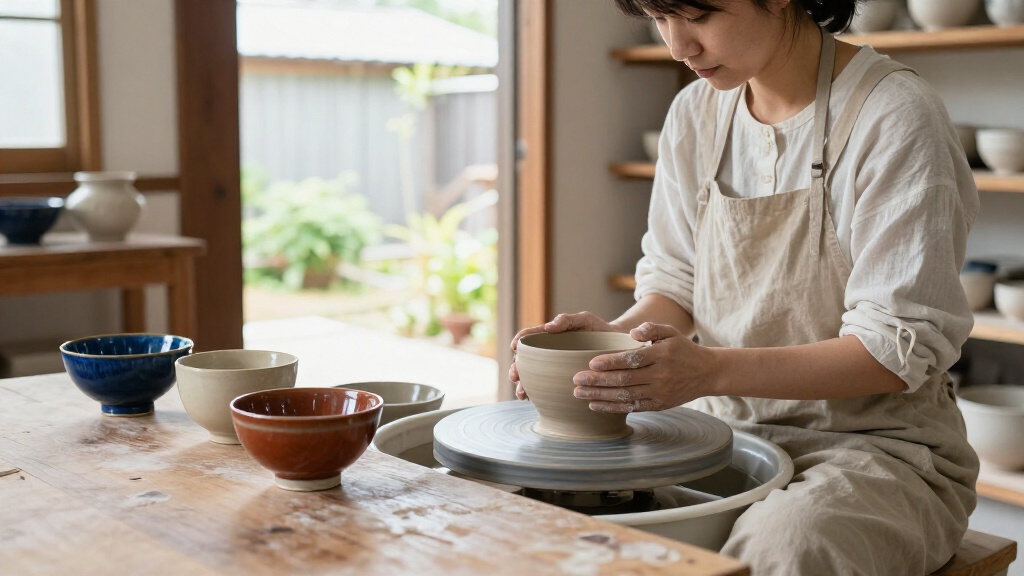
Kogei production can also involve many specialists rather than one maker. The report describes ceramics moving through workers with different expertise in clay, glaze, molds and firing, sometimes within one production region. Such divisions of labor depend on each specialist remaining available, making the health of the wider local network a concern beyond any individual object.
Everyday Objects Carry Regional Knowledge
The design implication in the report is a shift in how people look at and display household objects. A bowl, cloth or kettle can be valued not only for appearance or rarity, but also for how it works, where its materials and methods come from, and the knowledge involved in maintaining its usefulness. That perspective gives interiors a connection to place, use and shared skill, rather than treating objects as decoration detached from daily life.
The report also connects kogei to the future of traditional production. It cites a decline in Japan’s traditional craft workforce from 288,000 people in 1979 to 48,334 in 2022. Those figures point to a substantial contraction in the workforce, although the supplied report does not break down the causes or show how many workers are active in each craft today. Ogino says Nakagawa hopes to pass on the regional ecosystems that support making, not just products or techniques.
As an affiliate, we earn on qualifying purchases.
From Nara Cloth to Modern Homes
Nakagawa was founded in Nara in 1716 and, according to the supplied report, now works with more than 800 workshops across Japan. The company sells Japanese craft and develops home goods that bring traditional making into contemporary use. Its history provides the report’s perspective on how regional production can continue while household needs change.
The article also places kogei within a broader Japanese vocabulary that distinguishes art, craft and everyday craft. It says the Japanese government’s criteria for traditional crafts start with everyday use and lists 244 crafts, with at least one in each of Japan’s 47 prefectures. Those details help explain why the report treats ordinary function, rather than rarity or an artisan’s signature, as a defining feature.
The Scale of Craft Decline
The report gives workforce totals for 1979 and 2022, but the supplied material does not identify the data source, explain which occupations or industries are included, or detail why employment fell. It also does not quantify how many workshops or specialist roles remain at risk. The figures show a decline across the stated period; they do not, on their own, establish the condition of every regional craft or predict what will happen next.
The article presents kogei through Nakagawa’s interpretation and a selected example. It does not provide a full comparison of definitions across Japanese institutions or explain how the 244 listed traditional crafts are assessed. Readers should treat the report’s design lessons as its interpretation of kogei, not as a complete account of every craft practice in Japan.
Keeping Regional Skills in Use
The report does not announce a new policy, program or deadline. Its account points instead to the continuing need for regional workshops and specialist skills if everyday craft traditions are to remain workable. Nakagawa’s stated focus is on sustaining the networks that make production possible, while adapting objects to contemporary use.
For readers considering the idea at home, the report suggests looking beyond an object’s label: ask what it is for, where its materials and methods come from, and whether it is designed to keep serving daily life. Whether that approach can support craft businesses at a broader scale is not established by the article; the workforce figures and the future of individual production regions remain the larger unresolved issues.
Key Questions
What does kogei mean?
In the Livingetc report, kogei refers to useful objects shaped by local materials, inherited knowledge and the skills of makers. They are made for everyday life and can adapt as people’s needs change.
Does kogei have to be handmade?
No. The report says kogei is not defined by hand production. Machine-made goods can fit the idea when local knowledge and human judgment remain part of the process.
Does one artisan make each kogei object?
Not necessarily. The report says production may involve several specialists, such as workers handling clay, glaze, molds and firing for a ceramic piece.
Why does the report say kogei is at risk?
It cites a fall in Japan’s traditional craft workforce from 288,000 people in 1979 to 48,334 in 2022. The supplied report does not explain the causes or give a forecast.
How can kogei inform a home display?
The report encourages readers to notice an object’s everyday function, regional origins and making knowledge, not just its appearance or rarity. It does not prescribe a particular display style.
Source: rss
Halloween Picks
halloween
As an affiliate, we earn on qualifying purchases.