
TL;DR
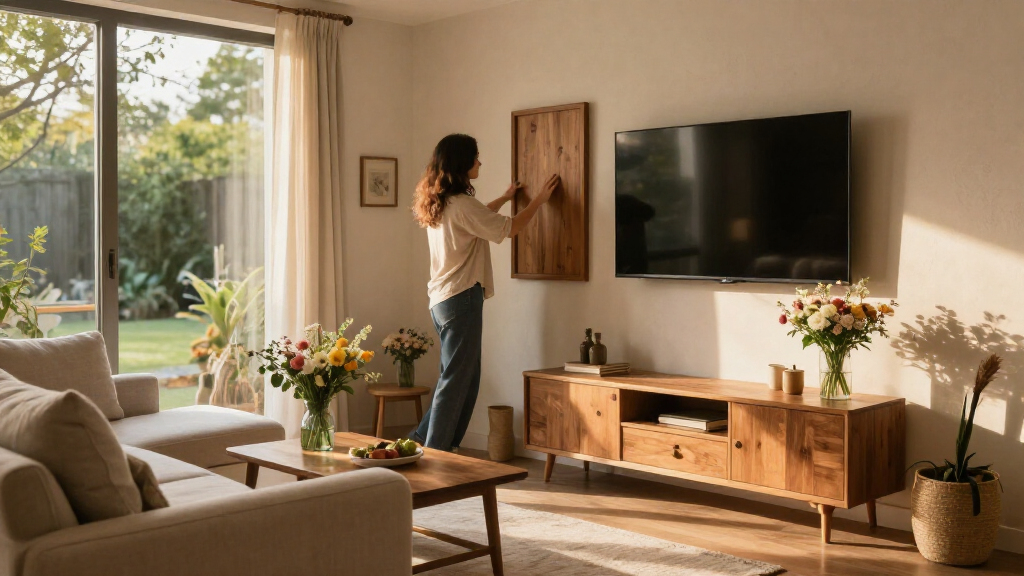
House Beautiful published a gallery titled “27 Creative Ways Designers Hide TVs,” showing design approaches such as cabinets, millwork, credenzas and art-like panels. The supplied report contains descriptions of 14 ideas, so details for the other 13 are not available here.
House Beautiful has published a gallery titled “27 Creative Ways Designers Hide TVs,” featuring projects that place screens behind cabinet doors, inside furniture and within decorative wall treatments. The supplied report describes 14 of the 27 listed approaches, illustrating how designers accommodate television viewing while keeping screens from dominating a room’s appearance.

Get decor and gifts delivered free with Prime
- Fast, free delivery on millions of items
- Prime Video, Amazon Music and more included
- Member-only deals all year
The examples range from straightforward storage to custom architectural features. In a Melbourne living room, designer Kylie Buhagiar of Golden concealed the television in a wall-hung metal cabinet with hinged doors that fold back. Vancouver designer Gillian Segal used a folding millwork door system, while designer John Wooden placed a screen inside a mid-century credenza in a cottage with limited space.
Other projects disguise the screen rather than fully enclosing it. Emily Del Bello mounted a television against a black accent wall to reduce its visual prominence. Designer Ariel Okin added a frame to a Samsung Frame TV so it could relate to other room details, and Denise McGaha used the same television style to echo a room’s blue-and-grey palette. Several projects use panels or artwork: Kristin Fine hid a screen behind modern paneling, while a bi-fold painting by Stuart Coleman Budd covers one in a project by architect Ken Pursley.
The gallery also includes more tailored solutions: fabric placed over cabinet glass, a steel-and-walnut feature wall with a floating credenza, a pagoda-shaped cabinet in an outdoor room, and a television in a kitchen. These are individual design examples, not evidence that one concealment method works for every room or budget. The supplied source text ends during its description of a pop-up television mechanism and does not include the full gallery.
Keeping Screens From Dominating Rooms
The examples address a common design tension: televisions are used for entertainment, but their dark rectangular screens can draw attention when turned off. Concealing or visually integrating a screen can help a room serve more than one purpose, such as a formal sitting area that also hosts movie nights, or a guest room where visitors can watch television without making it the room’s main feature.
The projects also show that concealment can affect function as well as appearance. Cabinet and millwork doors require space and access to open; a pop-up mechanism needs a suitable installation. By contrast, a Frame-style screen or a dark wall changes how visible the television appears but does not physically remove it. The gallery offers ideas, while the practical choice depends on the room, equipment and how residents use the screen.
Products Worth Considering

TCL 55-Inch R7D Series QLED 4K UHD HDR Roku Smart TV (55R7D, 2026)

Sonos Play Portable Wi-Fi and Bluetooth Speaker, Black

Sonos Roam Portable Bluetooth and Wi-Fi Speaker, Black
As an affiliate, we earn on qualifying purchases.
Fourteen Approaches in the Supplied Report
The House Beautiful gallery’s title promises 27 designer approaches. The material provided for this article describes numbered entries 1 through 14, including cabinets, millwork, framed screens, closets, credenzas, fabric, wall panels, a kitchen installation and a pop-up function. It does not supply descriptions for entries 15 through 27, so those approaches cannot be reported here.
The designers’ comments give limited project-specific context. Buhagiar said the cabinet was intended to let a main living room serve as a calm sitting area. Segal described a room used both as a formal living space and a family room, and said the folding doors were a cost-effective solution. Pursley said the hinges on the bi-fold painting were left visible to express that the panel moved. These statements describe the designers’ intentions; they do not establish general cost or performance outcomes.
““In the main living room, the TV is discreetly integrated into a wall-hung metal joinery box, with hinged doors that elegantly stack back to reveal the screen when needed.””
— Kylie Buhagiar, designer at Golden
Details Missing From the Gallery
The supplied source text contains only 14 described entries, despite the gallery title referring to 27. The remaining 13 ideas, and the complete description of the pop-up mechanism mentioned at the end of the supplied text, are not available in the material provided. The article also gives no publication date, project costs, installation specifications or comparative assessment of the methods.
Some examples name particular products, including Samsung Frame televisions, but the source does not provide technical guidance on ventilation, access to cables, screen dimensions or whether a given cabinet can safely hold specific equipment. Readers would need project details from the designer or installer before treating any example as a ready-to-build plan.
Check Fit Before Choosing a Method
Readers considering a similar approach can compare the idea with their room layout, viewing habits, equipment and storage needs. A cabinet or closet should allow the screen to be opened and used comfortably; a wall treatment or framed screen may be preferable when the goal is visual blending rather than full concealment. For custom cabinetry or a mechanical lift, homeowners can ask a qualified designer or installer about measurements, access and installation requirements.
The supplied report does not say whether House Beautiful will add the other gallery entries or provide more technical information. Until fuller project details are available, the examples are best treated as design references, not installation instructions.
Key Questions
What is the House Beautiful report about?
It is a gallery titled “27 Creative Ways Designers Hide TVs,” featuring designer projects that conceal or visually blend televisions into rooms. The supplied text describes 14 ideas.
What are some ways designers hide televisions?
The described examples include placing a television in a cabinet, closet or credenza; hiding it behind millwork or a painting; and reducing its visual prominence with a dark wall or a frame that matches the room.
Does the supplied report explain all 27 ideas?
No. The material provided contains descriptions of entries 1 through 14. It does not include the remaining 13 entries, and its final description of a pop-up function is cut off.
Does the gallery provide installation instructions or costs?
No costs or detailed installation instructions are included in the supplied text. Custom cabinetry and lift mechanisms should be discussed with a designer or qualified installer who can account for the room and equipment.
Source: housebeautiful.com